

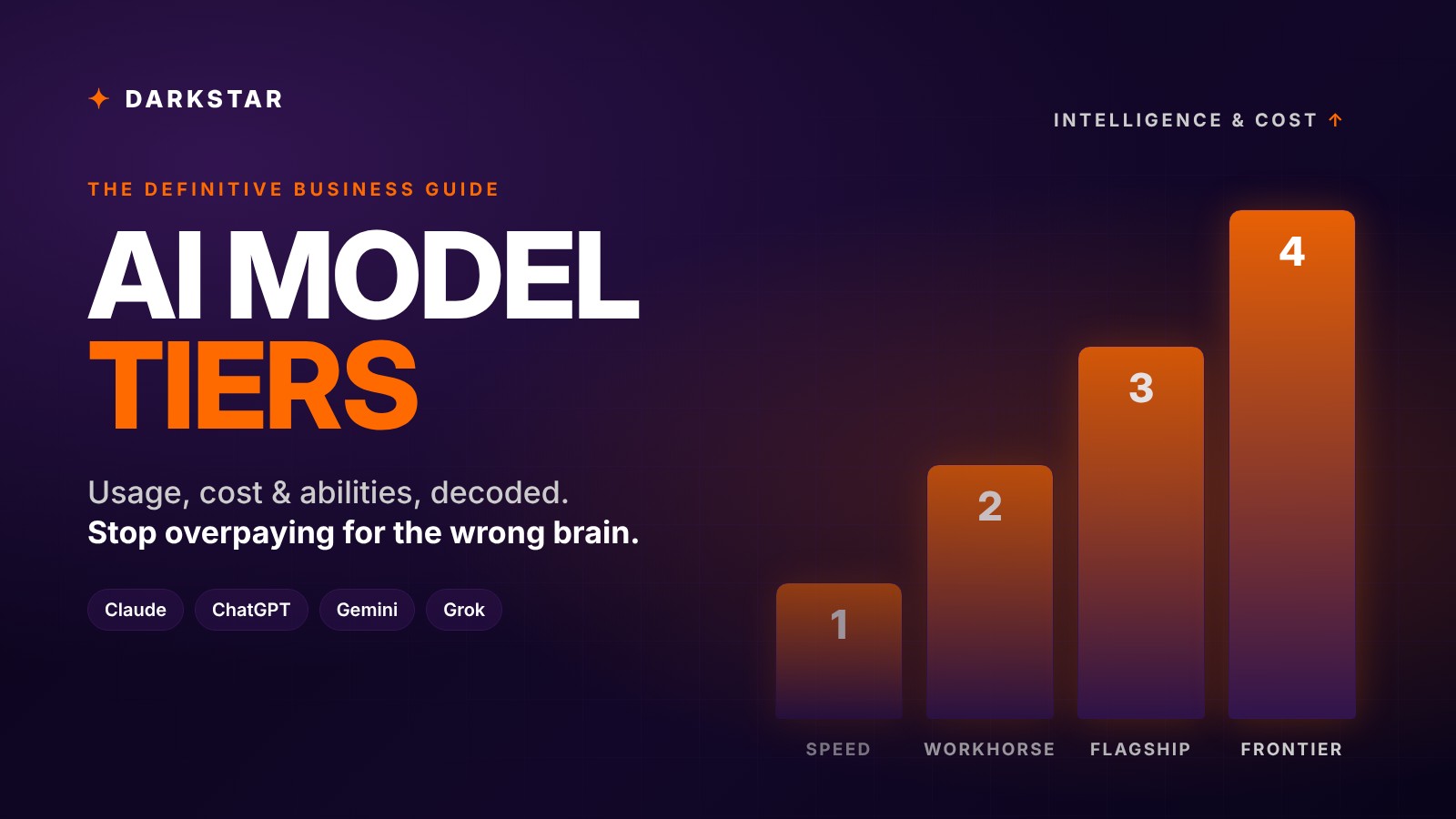
15 Oct AI Model Tiers Explained: Usage, Cost & Abilities (2026)
AI Model Tiers: The Definitive Business Guide
You’re Probably Using the Wrong AI Model Right Now
There’s a switch inside ChatGPT, Claude, Gemini, and Grok that most of your team has never touched. It’s the model picker, a small dropdown that decides which “brain” answers your question. Leave it on the default and you’re either overpaying for horsepower you don’t need or underpowering work that deserves better.
Every major AI provider now sells its intelligence in tiers: a fast, cheap model for everyday tasks, a balanced workhorse, and a heavyweight for the hard stuff. Some add a fourth, ultra-premium tier above that. The names are confusing on purpose-adjacent levels: Haiku, Sonnet, Opus. Nano, mini, Pro. Flash-Lite, Flash, Pro. Fast and Heavy.
This guide cuts through the naming. You’ll learn what a large language model actually is, who the major players are, how AI model tiers differ in ability and cost, why tokens are the real currency of AI, and exactly which tier to reach for during a normal business day. Business owners will see where the money goes. Technical decision-makers will get the framework for routing work to the right model. And everyone will finally know what that dropdown is for.
What Is an LLM? The 60-Second Version
A large language model (LLM) is software trained on an enormous amount of text to predict what words should come next. That sounds simple. At scale, it produces something that can draft a proposal, summarize a 90-page contract, write working code, and reason through a pricing decision.
Think of an LLM as a new hire who has read most of the internet but has never worked at your company. It knows a staggering amount in general. It knows nothing about your clients, your processes, or last quarter’s numbers unless you tell it. The quality of what you get back depends on two things: what you give it, and which model you’ve hired for the job.
Three terms will come up throughout this guide:
- Model: the specific “brain” doing the work, such as Claude Sonnet or GPT-6 Sol.
- Prompt: the instructions and material you hand the model.
- Context window: how much the model can hold in its head at once. Most current flagship models handle around 1 million tokens, roughly 750,000 words, or several thick binders of documents in a single conversation.
The Major Players: Who Builds the Brains
Four companies dominate the AI models your business is most likely to touch in 2026. Each sells its models two ways: through a chat app with a monthly subscription, and through an API (application programming interface) that developers and automation tools pay for by usage.
Anthropic (Claude). Anthropic’s Claude family has the most consistent tier naming in the industry, built around poetry forms that grow with ambition: Haiku (fast and light), Sonnet (balanced), and Opus (the flagship). Above Opus sits a newer premium tier, Fable, the public version of Anthropic’s most powerful Mythos-class model. Claude is especially popular for writing, document analysis, and coding.
OpenAI (ChatGPT / GPT). The company that started the mainstream AI wave. Its current GPT-6 generation uses celestial names: Luna (fast and low-cost), Sol (the everyday workhorse), and Astra (the most capable, labeled GPT-6 Pro inside ChatGPT). Older names like mini, nano, and Pro still appear across previous generations, which is a big reason people get confused.
Google (Gemini). Gemini is built into Google Workspace, Search, and Android, so many employees already use it without realizing it. Its tiers are Flash-Lite (budget), Flash (fast everyday work), and Pro (deep reasoning). The newest flagship, Gemini 4 Argon, became generally available on October 13, 2026.
xAI (Grok). Elon Musk’s AI company built Grok, which is integrated into X (formerly Twitter) and stands out for real-time access to news and social conversation. xAI keeps a flatter lineup: an efficient everyday model, a flagship (currently Grok 4.7), and a multi-agent Heavy configuration on its top subscription.
Worth knowing about: Meta’s Llama, France-based Mistral, and China-based DeepSeek offer “open-weight” models a company can run on its own servers. They matter for businesses with strict data-control requirements or very high volume, but most teams meet AI through one of the big four.
What Are AI Model Tiers, and Why Do They Exist?
AI model tiers are different sizes of the same model family, each trading intelligence against speed and cost. Bigger models have more internal capacity to reason, catch nuance, and handle multi-step problems. That capacity requires more computing power for every word they read and write, which makes them slower and more expensive to run.
Providers sell tiers because no single model is right for every job. Sorting 5,000 support tickets does not need the same brain as restructuring a 40-page acquisition agreement. Tiers let you match horsepower to the task.
The easiest way to understand them is to picture your own staffing chart:
- Tier 1, Speed (the sharp intern): fast, cheap, tireless. Great for high-volume, clearly defined work. Will miss subtlety on hard problems.
- Tier 2, Workhorse (the experienced professional): the best balance of quality, speed, and cost. Handles 80% of knowledge work well. This should be your default.
- Tier 3, Flagship (the senior expert): deeper reasoning, better judgment on ambiguous problems, stronger on long and complex tasks. Slower and pricier.
- Tier 4, Frontier (the specialist consultant): the absolute top end. Extended reasoning, multi-agent setups, or premium research-grade models. Brilliant, expensive, and overkill for most daily work.
Not every provider fills all four slots, and the line between Tier 3 and Tier 4 blurs. But the principle holds everywhere: you pay for intelligence in proportion to how much of it you use.
One more twist: many current models also have a reasoning effort or “thinking” setting. Turning it up makes any tier think longer before answering. It improves results on hard problems and burns more tokens doing it. Think of tiers as who you hire and effort as how long you let them think.
Tokens: The Real Currency of AI
Every AI provider measures work in tokens, and once you understand them, AI pricing stops being mysterious.
A token is a chunk of text, usually a word or part of a word. A rough rule of thumb: 1,000 tokens is about 750 words. A short email is around 200 tokens. A 10-page report is around 5,000. A thick contract can easily pass 50,000.
Tokens are counted in both directions:
- Input tokens are everything the model reads: your question, any pasted text, attached files, and the whole conversation history so far.
- Output tokens are everything the model writes back, including any behind-the-scenes “thinking” it does before answering.
Output tokens typically cost about 5 times more than input tokens, because generating new text is harder work than reading it. That’s why asking for a long report costs more than asking a question about one.
How Much More Does Each Tier Cost Per Token?
This is where tiers get real. Across the major providers, the price jumps between tiers are steep:
- Anthropic and OpenAI both price their workhorse tier (Sonnet, Sol) at roughly 20x their speed tier (Haiku, Luna) per token. Claude Opus runs about 40x Haiku, and the frontier tier (Claude Fable, GPT-6 Astra) lands around 100x the cheapest model.
- Google keeps a tighter ladder: Flash costs roughly 1.5x to 2.5x Flash-Lite, and Pro-class models run roughly 5x to 8x Flash-Lite.
- xAI is flattest of all: its flagship Grok 4.7 costs only around 2x its efficient model per token, with the multi-agent Heavy mode reserved for its most expensive subscription.
Put plainly: a task that costs a fraction of a penny on a speed-tier model can cost several cents on a frontier model. At one task, nobody cares. At 10,000 tasks a month through an automated workflow, that’s the difference between a rounding error and a real line item.
Your Subscription Is a Prepaid Token Allowance
Here’s the part most employees never hear: a $20/month ChatGPT, Claude, Gemini, or Grok plan is essentially a bundle of tokens. The app doesn’t show a meter in dollars, but behind the scenes every message draws down a usage allowance, typically reset every few hours and every week.
Because premium tiers cost more per token, they drain that allowance faster. On Anthropic’s plans, for example, Opus visibly consumes allowance faster than Sonnet, and the Fable tier draws down limits faster still. Upgrading to a $100 or $200 plan mostly buys a bigger allowance, not a smarter model.
That’s why people “mysteriously” hit their limit by 2 p.m. They left the picker on the most powerful model, pasted in long documents, and kept one marathon conversation running all day, which means the model rereads the entire history with every new message.
The fix is simple: use the lightest tier that does the job well, start fresh conversations for new topics, and save the heavy models for work that actually needs them.
AI Model Tiers Compared: Provider by Provider
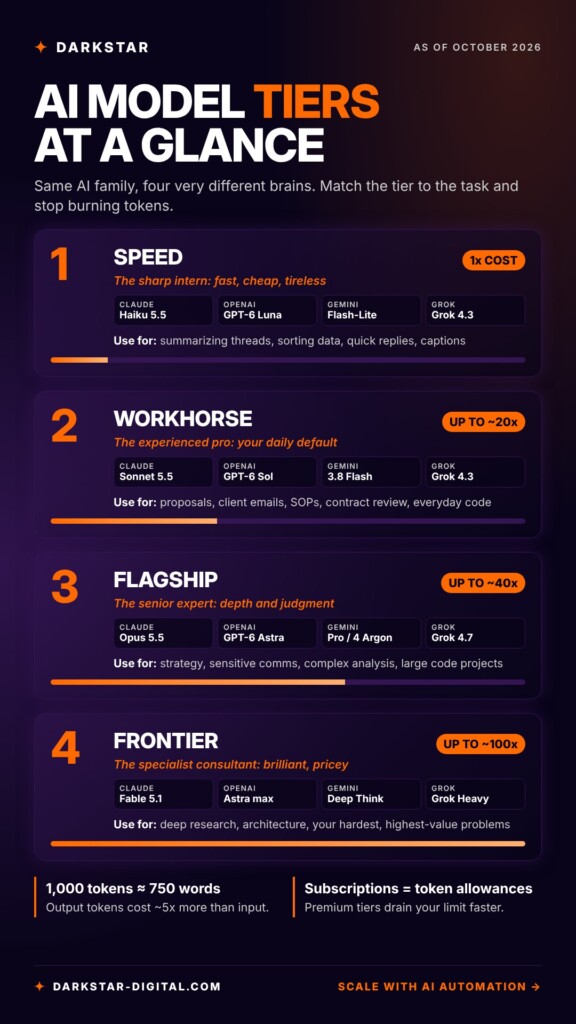
Here’s how each provider’s current lineup maps to the four tiers, as of October 2026. Relative cost compares each model’s per-token price to that provider’s cheapest current model.
| Tier | Anthropic (Claude) | OpenAI (GPT-6) | Google (Gemini) | xAI (Grok) | Relative cost per token |
|---|---|---|---|---|---|
| 1. Speed | Haiku 5.5 | Luna | 3.5 Flash-Lite | Grok 4.3 | 1x (baseline) |
| 2. Workhorse | Sonnet 5.5 | Sol / 6.1 Sol | 3.8 Flash | (Grok 4.3 covers this) | ~2x (Google) to ~20x (Anthropic, OpenAI) |
| 3. Flagship | Opus 5.5 | Astra | 3.1 Pro / 4 Argon | Grok 4.7 | ~2x (xAI) to ~40x (Anthropic) |
| 4. Frontier | Fable 5.1 | Astra at max reasoning (GPT-6 Pro in ChatGPT) | Deep Think mode | Grok Heavy (subscription only) | Up to ~100x |
Tier 1: Speed Models
Haiku, Luna, Flash-Lite, and Grok’s efficient models respond almost instantly and cost a sliver of a cent per task. Today’s speed tier is far smarter than flagship models from two years ago. They handle summarizing, sorting, extracting, translating, and short drafting with ease. Their weakness is subtle judgment: give them an ambiguous, high-stakes problem and they’ll answer confidently, just not as wisely.
Use when: the task is clear, repetitive, or high-volume, and a quick human glance can catch mistakes.
Tier 2: Workhorse Models
Sonnet, Sol, and Flash are the sweet spot. They write well, follow detailed instructions, analyze documents, and handle most coding and research tasks. For the typical employee, this tier should be the default setting.
Use when: you’re doing real knowledge work and want quality without waiting or overspending.
Tier 3: Flagship Models
Opus, Astra, Gemini Pro and Argon, and Grok 4.7 are built for complex, multi-step work: long agentic tasks, difficult analysis, nuanced writing where tone carries risk, and code that touches many files at once. They’re slower, and they spend your allowance faster.
Use when: the workhorse gave you a mediocre answer, or the cost of a wrong answer is high.
Tier 4: Frontier Models
Claude Fable, GPT-6 Astra at maximum reasoning, Gemini Deep Think, and Grok Heavy sit at the edge of what AI can do. Some run multiple AI agents that check each other’s work. Some think for minutes before answering. On consumer plans they’re often limited, metered separately, or available only on top-tier subscriptions.
Use when: the problem is genuinely hard, novel, and valuable: a major strategic decision, a gnarly technical architecture, or deep research you’d otherwise pay a consultant for.
Which Tier for Which Task: A Normal Business Day
Theory is nice. Here’s what tier selection looks like across a real workday, department by department.
Email and Communication
- Speed tier: “Summarize this 47-message email thread and tell me what I’m being asked to do.” Turn rough meeting notes into clean bullet points. Draft a quick “got it, I’ll follow up Friday” reply.
- Workhorse tier: Draft a polished client update explaining a project delay. Rewrite a blunt message so it lands diplomatically. Turn a meeting transcript into minutes with decisions, owners, and deadlines.
- Flagship tier: Prepare a sensitive message to a key client after a service failure, where every sentence carries relationship and legal weight.
Sales and Marketing
- Speed tier: Generate 20 subject line variations. Write first-pass social captions. Pull company names, titles, and pain points out of a stack of discovery call notes.
- Workhorse tier: Draft a tailored proposal from your template and the client’s RFP. Write landing page copy and ad sets in your brand voice. Summarize a competitor’s website and pricing into a one-page battle card.
- Flagship tier: Build a go-to-market plan for a new service line. Analyze six months of win/loss notes to find why deals actually stall.
- Frontier tier: Deep market research on a new vertical, synthesizing dozens of sources into a defensible strategy brief.
Operations and Admin
- Speed tier: Clean up and standardize a messy contact list. Categorize 500 expense entries. Convert a voice memo into a checklist.
- Workhorse tier: Write a standard operating procedure (SOP) from a recorded walkthrough. Explain what’s driving the numbers in a sales spreadsheet. Build a weekly report template.
- Flagship tier: Map a messy, multi-department workflow and identify the real bottlenecks. Reconcile conflicting data from three systems and explain the discrepancies.
HR and Management
- Speed tier: Reformat job postings for different job boards. Summarize employee survey comments into themes.
- Workhorse tier: Draft a job description from a hiring manager’s rambling notes. Turn bullet-point feedback into a balanced, specific performance review draft. Write an onboarding checklist.
- Flagship tier: Draft or revise a company policy (remote work, AI use, PTO) where precise, fair language matters, ready for legal review.
Technical Work
- Speed tier: Explain an error message. Write a simple spreadsheet formula. Convert data from one format to another.
- Workhorse tier: Write and debug everyday scripts and code. Analyze a 60-page vendor contract and flag unusual terms. Compare three software options against your requirements.
- Flagship tier: Refactor code across a large project. Plan a system integration. Run a long agentic task that works through dozens of steps on its own.
- Frontier tier: Design the architecture for a new internal platform. Tackle a problem your team has been stuck on for weeks.
The pattern: roughly 70 to 80% of a typical employee’s AI tasks belong on the speed or workhorse tier. The premium tiers earn their price on the 20% of work where judgment, depth, and accuracy carry real money.
How to Switch Models (and Pick the Right One)
The model picker is usually hiding in plain sight. In ChatGPT, Claude, Gemini, and Grok, look for the model name near the top of the chat or beside the message box. Click it and you’ll see the available tiers. Your options depend on your plan: free plans are typically limited to the speed tier, while paid plans unlock the workhorse and flagship models, and top-tier subscriptions add frontier models.
Many apps also offer an “auto” mode that picks a model for you. It’s convenient, but it optimizes for the provider’s capacity as much as your outcome. When the work matters, choose deliberately.
A Simple Four-Question Rule
- Is this task repetitive, short, or clearly defined? Start on the speed tier.
- Is it real knowledge work: writing, analysis, research? Use the workhorse tier. This is your default.
- Did the answer come back shallow, or is a mistake expensive? Step up to the flagship.
- Is this a genuinely hard, high-value problem you’d normally hire an expert for? That’s frontier territory.
Tips That Stretch Your Allowance
- Start new chats for new topics. Long conversations get reread with every message, quietly multiplying your token use.
- Escalate, don’t default up. Try the workhorse first. Move up only when the output falls short.
- Give better input. A clear prompt on a mid-tier model often beats a lazy prompt on a flagship.
- Turn reasoning effort down for simple tasks. “Thinking” modes are powerful and token-hungry.
For Technical Decision-Makers: Route, Don’t Choose
Inside a company, the bigger opportunity isn’t training 50 employees to pick models correctly. It’s building workflows that route tasks to the right tier automatically. A well-designed AI workflow sends high-volume classification and extraction to a speed model, drafts and analysis to a workhorse, and escalates only the hard cases to a flagship. Because tier prices differ by up to 100x, smart routing can cut AI costs dramatically while improving quality where it counts. That’s not a settings tweak. It’s architecture.
AI Model Tiers: Frequently Asked Questions
What are AI model tiers?
AI model tiers are different versions of the same AI model family, sized for different jobs. Smaller tiers are faster and cheaper; larger tiers reason more deeply and cost more per token. Most providers offer three or four tiers, from a speed model up to a flagship or frontier model.
Is the most expensive AI model always the best choice?
No. Premium models are better at hard, ambiguous problems, but for simple tasks they often produce the same result as a speed model, just slower and at many times the cost. The best choice is the lightest tier that does the job well.
What is a token in AI?
A token is a small chunk of text, roughly three-quarters of a word. AI providers measure and price usage in tokens, counting both what the model reads (input) and what it writes (output). Output tokens usually cost about 5 times more than input tokens.
Why do I keep hitting my ChatGPT or Claude usage limit?
Subscriptions include a usage allowance that resets periodically. Premium models, long documents, and very long conversations all burn through that allowance faster. Switching routine work to a lighter tier and starting new chats for new topics usually solves it.
Does a more expensive subscription give me a smarter AI?
Mostly, it gives you more usage. Upper plans may unlock top-tier models, but the main difference between a $20 plan and a $100 or $200 plan is how many tokens you can use before hitting a limit.
Which AI model tier should most employees use by default?
The workhorse tier: Claude Sonnet, GPT-6 Sol, or Gemini Flash. It handles most writing, analysis, and research well, at a fraction of flagship cost. Drop to the speed tier for simple, repetitive tasks and step up only when quality falls short.
Are AI model names going to keep changing?
Yes. Providers release new versions every few months, and naming schemes shift between generations. The tier structure is the stable part: there will almost always be a fast, cheap option, a balanced workhorse, and a premium flagship. Learn the tiers and the names become easy to decode.
Can a business automatically choose the right model tier?
Yes. Through APIs, businesses can build AI workflows that route each task to the appropriate tier based on complexity, cost, and risk. This model routing is one of the most effective ways to control AI costs at scale.
Stop Picking Models. Start Building Leverage.
Knowing your AI model tiers puts you ahead of most of the workforce. Most people never touch the picker. They overpay on easy tasks, underpower the hard ones, and hit their limits by lunch.
But the real unfair advantage isn’t a team that picks the right model every time. It’s a business where the right model is picked automatically, where routine work flows to fast, cheap models around the clock, complex work escalates to the heavy hitters, and your people spend their time on decisions only humans should make.
That’s what Darkstar Digital builds. Our Autonomous AI Workflows connect the right AI tier to every step of your operation, eliminating bottlenecks, integrating your data silos, and turning AI from a chat window into Digital Capital that compounds.